
Quick Summary
The best custom wedding print items are invitations and save-the-dates, RSVP and thank-you cards, ceremony programs, signs, photo prints and menu cards, all designed together for a consistent look. Compare vendors by normalizing quotes to the same specification and separating one-time costs from per-piece costs.
- Choose invitations and save-the-dates together so fonts, colors and paper match.
- Order a few extra invitations, since replacement runs for a few pieces cost more per card.
- A 100 lb cover stock is a typical mid-weight invitation card; 110-130 lb feels more substantial.
- Ask for production time measured from proof approval, and add the shipping window.
- Compare vendors on the full set of items, including envelopes, design fees and shipping.
Table of Contents
- Custom Wedding Invitations and Save-the-Dates
- RSVP Cards and Thank-You Cards
- Wedding Ceremony Programs
- Custom Wedding Signs and Welcome Boards
- Wedding Photo Prints and Menu Cards
- Comparing Print Vendors, Costs and Timelines
- Booking Your Print Order Before Your Wedding Date
- Frequently Asked Questions
9 High Quality Custom Wedding Print Items Worth Ordering
Last Updated: November 7, 2026
Custom Wedding Invitations and Save-the-Dates
Custom wedding print is where most couples start, and it is also where budgets tend to grow fastest. Browse the full range of printing products to see what is available for your stationery. A common pattern is to order invitations first, then realize matching save-the-dates, RSVP cards, and place cards are also needed. Planning the full set from the beginning keeps the design consistent and the costs easier to track.
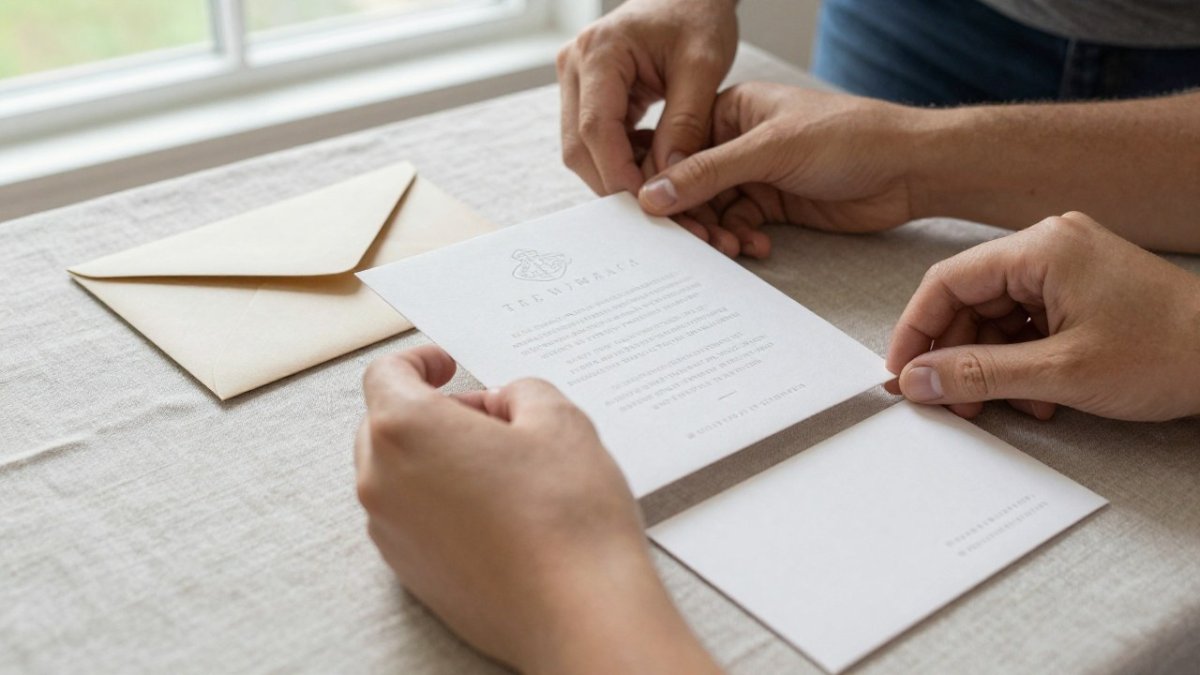
Invitations and save-the-dates share a design system, so choose them together. A save-the-date sets the tone, and the formal invitation should carry the same fonts, colors, and paper choices. Wedding stationery guidance from The Knot suggests many couples send save-the-dates several months before the wedding, which gives you a clear ordering deadline to work backward from.
Pricing depends on quantity, size, paper, finish, and turnaround. Request a quote from C3 DesignsBiz with your artwork, quantities, and deadline to get current pricing for your order.
Watch out: Order a few extra invitations beyond your guest count. Envelopes get damaged, and a replacement run for two or three pieces often costs more per card than the original order.
Paper Stock and Finish Options
Paper weight and finish change how an invitation feels in the hand and how it survives the mail, so they deserve a decision of their own. In the U.S., cardstock is commonly described in pounds (lb) for text and cover stocks or in points (pt) for thickness; a 100 lb cover stock is a typical mid-weight invitation card, while 110-130 lb cover feels more substantial and resists bending in transit. Thinner stock is lighter and cheaper to ship, but it can show ink bleed on dark designs and may curl in humid conditions.
Common finish options include:
Print-Ready Artwork, Bleed, and Proofing
Most costly print errors happen before the file reaches the press. Print-ready artwork usually needs a bleed area beyond the trim size, adequate resolution at final size, and the correct color mode. Low-resolution photos look blurry at larger sizes.
Ask your vendor for its file requirements before you design, and request a proof. Check names, dates, times, and the spelling of every guest-facing line, and have a second person read the proof cold.
RSVP Cards and Thank-You Cards
RSVP cards are functional, but they still shape how guests see your wedding. Keep the layout simple, include a clear response date, and match the design of the invitation. A mismatched RSVP card looks like an afterthought.
Thank-you cards are the last printed piece most guests will see. Many couples order them in a smaller size and use a photo from the wedding on the front. A photo card of this kind is a strong use of wedding photo print guidance best practices, because the image does most of the work.
Wedding Ceremony Programs
Ceremony programs are a good place to add personality without much cost. They list the order of events, introduce the wedding party, and often carry a short note from the couple. Because they are read once and then kept, a booklet format with a cover image is worth considering.
Order programs with enough copies for guests seated at the ceremony, plus a few spares for the officiant and family. Printing a few extras costs little and avoids last-minute reprints.
Custom Wedding Signs and Welcome Boards
Signs set the tone before guests reach the reception. A welcome sign at the entrance, a seating chart on an easel, and a bar menu sign all do different jobs. Think about where each sign will stand and how far guests need to read it from.
Vinyl banners are a common choice for large displays. Measure your display space before choosing a size, because a sign that is too small is hard to read from across a room.
Use a clear, large font and avoid dense text. Guests will glance at these signs for a few seconds, so keep the message short.
Wedding Photo Prints and Menu Cards
Photo prints add a personal touch to the reception. Common uses include a photo timeline, framed engagement portraits, and prints in guest books. Choose a print size that matches the display and check the image resolution before you order, because low-resolution photos look blurry at larger sizes.
Menu cards are another practical item. They tell guests what they are eating and can carry the wedding design forward. Keep the layout clean, use the same fonts as the invitations, and print enough copies for each table.
Comparing Print Vendors, Costs and Timelines
Most couples compare print vendors on the sticker price of one item, then discover the real cost after shipping, design fees, and reprints are added. A better approach is to normalize every quote to the same specification so the numbers are actually comparable, and to separate one-time costs from per-piece costs. Once the full cost of each printed piece is clear, the same careful budgeting can help couples choose useful keepsakes such as Evergreen Favors without letting favors become an afterthought.
Normalize the quote before you compare. Give every vendor the same brief: item type, finished size, paper weight and stock, finish, quantity, and in-hands date. Ask each to quote the full set, invitations, envelopes, RSVP cards, and any inserts, rather than one piece. A vendor that looks cheap on invitations may charge more for envelopes or require a separate design fee, which flips the total.
Separate the cost stack. A print quote usually bundles several line items that behave differently:
- Design and file setup: one-time, often waived if you supply print-ready artwork
- Paper and stock: scales with quantity but jumps at certain weights and specialty sheets
- Finishes: foil, letterpress, and edge painting are typically priced per piece and per location, so two foil accents cost more than one
- Envelopes and addressing: often quoted separately; printed return addresses and guest addressing add per-envelope charges
- Shipping: weight and box size matter, and heavy cardstock ships at a higher rate than thin stock
- Rush fees: usually a percentage surcharge on the whole order, not a flat add-on
Build a budget sheet with unit economics. List each item with quantity, unit price, setup fee, shipping, and tax, then calculate a true cost per guest. Stationery is one of the easier wedding costs to adjust, so set a total early and let the per-guest number guide where to add or cut. wedding budget planning guidance from The Knot is a reasonable starting reference for how stationery fits into the overall budget.
Compare turnaround on the same clock. Ask each vendor for production time measured from proof approval, not from order date, and add the shipping window. Build a buffer before your mailing deadline; a rush order that arrives late costs more than a standard order placed on time.
Ask about proofing and reprints in writing. Confirm whether the vendor provides a digital proof, a physical proof, or both, and who pays for a reprint if the error is the vendor's. A physical proof is worth requesting on any order with foil, letterpress, or dark ink on dark stock, because those are the combinations where screen color and printed color diverge most.
Ask these questions before you commit:
- Do you check artwork files before printing, and do you provide a digital or physical proof?
- What paper weights and finishes are standard, and which cost extra?
- Is production time measured from proof approval, and is rush service offered?
- Are envelopes, addressing, and shipping included in the quote?
- What is the reorder process and price if I need more copies later?
The article breaks a print quote into separate cost lines, so the table below shows what each one covers and how it is priced.
| Cost line | Behaviour | Note |
|---|---|---|
| Design and file setup | One-time | Often waived with print-ready artwork |
| Paper and stock | Scales with quantity | Jumps at certain weights and specialty sheets |
| Finishes | Priced per piece and location | Two foil accents cost more than one |
| Envelopes and addressing | Quoted separately | Printed return addresses add per-envelope charges |
| Shipping | Based on weight and box size | Heavy cardstock ships at a higher rate |
| Rush fees | Percentage surcharge | Applied to the whole order, not a flat add-on |
Booking Your Print Order Before Your Wedding Date
Start by listing every printed item you need, along with quantities and deadlines. Save-the-dates usually go out first, followed by invitations, then RSVP cards, programs, signs, and menus. Work backward from the wedding date to set order deadlines for each item.
Prepare your artwork before you contact a printer. Print-ready files usually need a bleed area, a high resolution, and the correct color mode. Ask your vendor for its file requirements so you do not lose time on revisions.
When you are ready to order, request a quote from C3 DesignsBiz to confirm current pricing and timing for your wedding print items. Order early, proof carefully, and leave room for corrections so your printed pieces arrive in time for every part of the celebration.
Ready to plan your wedding print order? C3 DesignsBiz helps couples create matching invitations, programs, signs, and cards with clear quotes and reliable production timing. Request a quote for your custom wedding print items today.
Frequently Asked Questions
What wedding items can be custom printed?
Most couples start with invitations and save-the-dates, then add other printed pieces for the celebration. Pricing depends on quantity, paper choice, finishes and delivery date, so request a quote from C3 DesignsBiz on the website for current figures before you commit to a budget.
What paper is best for wedding invitations?
Heavier cardstock feels more substantial than standard paper. Ask your printer for paper samples before ordering, since color and weight look different in person than on a screen.
How many wedding programs should I print?
A common approach is to print one program per guest, plus about 10 percent extra for keepsakes and late arrivals. Count the guests you expect to attend the ceremony, not the reception, and confirm the final number once RSVPs come in. Ordering a small buffer is usually cheaper than a rush reprint closer to the date.
Can I print wedding signs and stationery at the same place?
Confirm with the provider which products it can produce and in what sizes before you order.
