
Table of Contents
- Understanding Business Card Paper Weight and Thickness
- Business Card Paper Types: What Sets Them Apart
- Matte vs. Glossy Business Cards: Finish Comparison
- How Paper Choice Affects Perceived Quality and Brand Image
- Practical Considerations: Printer Compatibility, Writing Performance, and Durability
- Cost, Sustainability, and Ordering Decisions
- Quick Decision Framework: Matching Stock to Your Design and Purpose
- Frequently Asked Questions
Last Updated: October 11, 2026
Understanding Business Card Paper Weight and Thickness
When you're choosing the right paper for business cards, weight and thickness determine how substantial your card feels, how durable it is, and how professional your brand appears.
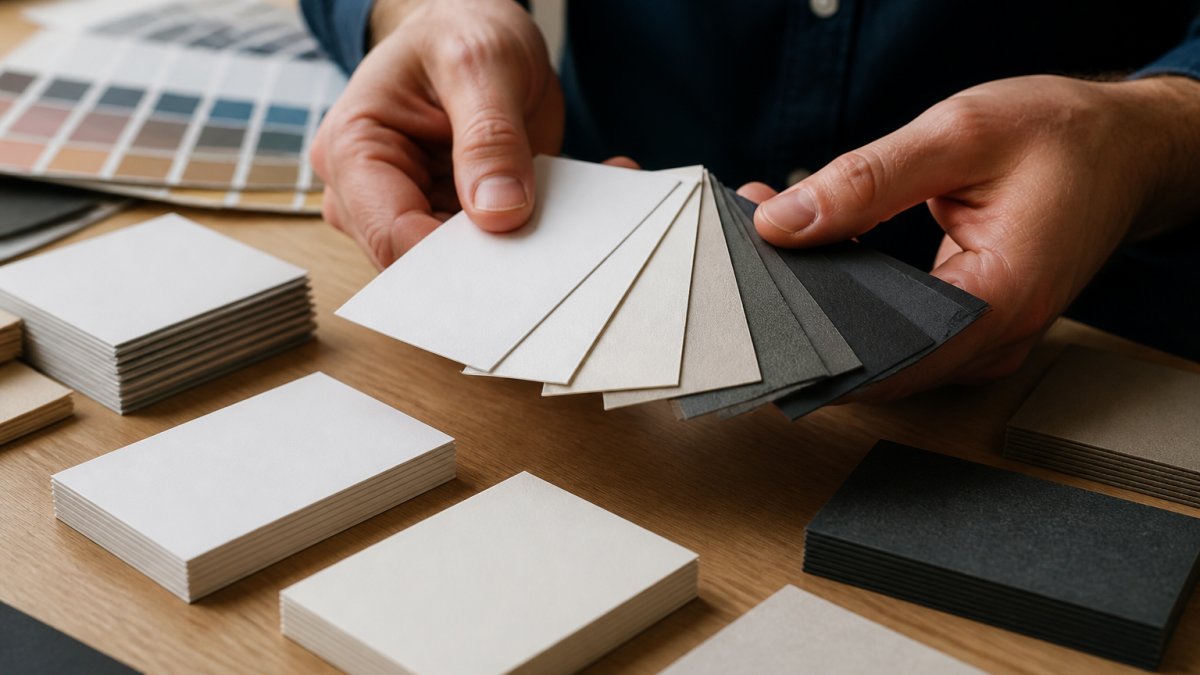
Paper weight is measured in pounds (lb) per ream, thickness in points (pt). Standard business cards use 14 pt cardstock (roughly 80 lb cover stock). Premium options at 16 pt or 18 pt feel noticeably thicker and more substantial.
Thicker isn't always better. The sweet spot for most professionals falls between 14 pt and 18 pt: affordable and easy to distribute at 14 pt, commanding attention without becoming unwieldy at 16-18 pt.
Standard vs. Premium Stock Options
Standard business card stock (14 pt) is the industry default: reliable, prints cleanly, and affordable in volume. Most businesses use it because it works.
Premium stock (16 pt and up) differs in fiber content, finish quality, and overall impression. A 16 pt matte card feels more expensive than a 14 pt glossy card, even with modest cost difference. Premium cards register as higher quality instantly.
Premium stock costs more in materials and production. For startup founders or independent professionals making first impressions, the premium feel often justifies the expense.
Business Card Paper Types: What Sets Them Apart
Paper composition and coating dramatically affect performance, appearance, and durability. Understanding these types helps you match your choice to your actual use case.
Coated vs. Uncoated Business Cards
Coated cardstock has a finish layer (matte, glossy, or hybrid) that protects the paper and enhances color reproduction. Glossy produces vibrant colors and shine; matte offers protection with a refined appearance.
Uncoated cardstock exposes the paper surface, creating a natural, tactile feel ideal for brands emphasizing authenticity. The downside: more susceptible to scuffing and fingerprints, with less vibrant colors. An uncoated card signals substance over flash.
Coated stock feels polished and protected; uncoated feels raw and intentional. Choose based on your brand image and desired impression.
Specialty Finishes: Soft-Touch, Linen, and Pearl
Beyond the standard matte and glossy divide, specialty finishes add another layer of differentiation. These are the choices that make a business card genuinely memorable.
Soft-touch finish applies a velvety coating that feels luxurious and commands attention. Trade-off: more delicate and shows fingerprints over time.
Linen texture embeds a subtle woven pattern into the cardstock. It mimics the appearance and feel of fine linen fabric, adding visual interest without overwhelming the design.
Pearl finish incorporates pearlescent elements that create a subtle shimmer when light hits the card. It's more understated than glossy but adds dimension that matte finishes can't achieve.
Matte vs. Glossy Business Cards: Finish Comparison
The matte versus glossy decision is one of the most consequential choices in choosing the right paper for business cards. These two finishes represent fundamentally different aesthetic and functional approaches.
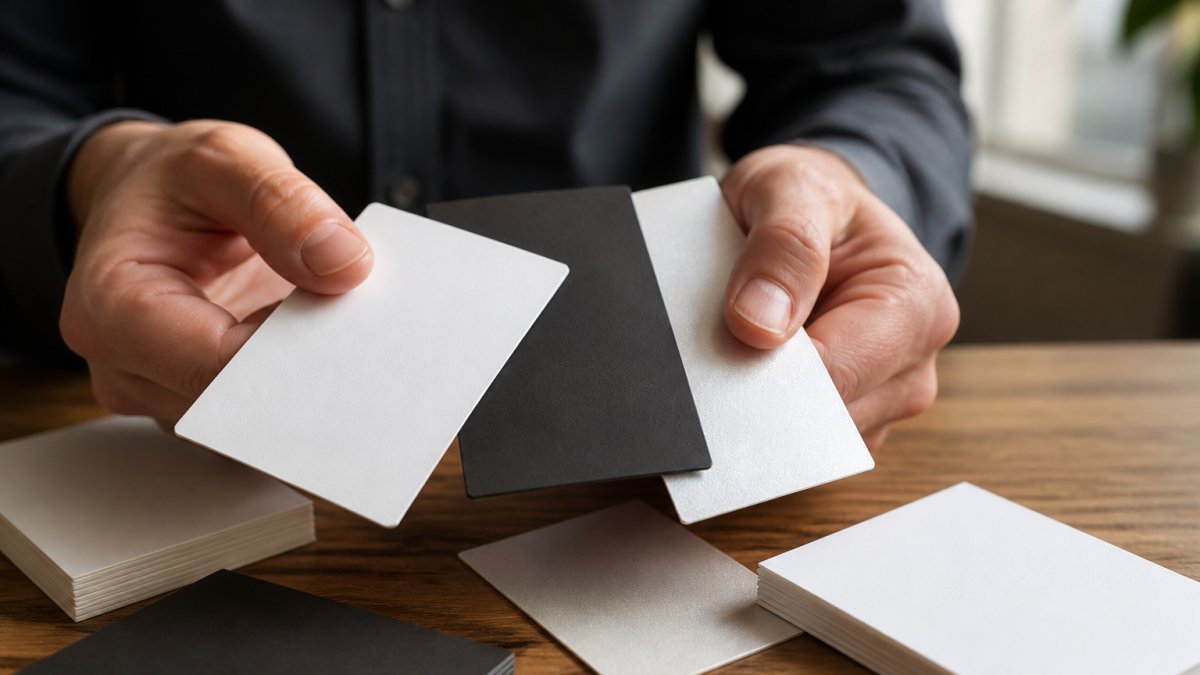
Glossy finishes reflect light and create a shiny surface that makes colors pop. Photographs and gradients look more vibrant on glossy stock. If your design relies on rich color reproduction and visual impact, glossy is the natural choice.
Matte finishes absorb light rather than reflecting it, creating a sophisticated, understated appearance. Text reads more clearly on matte stock because there's no glare. Colors appear slightly more muted than on glossy, but that subtlety often feels more professional and refined.
Print Quality and Color Reproduction by Finish
The finish you choose directly impacts how your design appears in print. Glossy finishes deliver maximum color saturation and contrast. If you're printing a design with deep blues, rich reds, or complex photography, glossy will render those colors more faithfully and vibrantly. This is why glossy remains popular for promotional cards and creative industries where visual impact matters.
Matte finishes sacrifice some color intensity in exchange for a more refined appearance. Blues stay blue, but they're less electric. Reds are less aggressive. For minimalist designs, typography-heavy cards, or professional services, this trade-off favors matte. The reduced glare also makes text easier to read, which matters if your card includes small-print contact information.
Tactile Experience and Professional Appearance
How a card feels in someone's hand shapes their perception of your brand before they even read it. Glossy finishes feel smooth and slick. They signal creativity, boldness, and visual sophistication. Matte finishes feel more grounded and intentional. They signal professionalism, confidence, and substance.
Neither finish is universally "better." A creative agency might choose glossy to reinforce its visual focus. A financial advisor might choose matte to project stability and professionalism. The key is alignment: your finish should reinforce what your brand actually does.
How Paper Choice Affects Perceived Quality and Brand Image
The moment someone receives your business card, their brain makes instant judgments about your business based entirely on what they're holding. This isn't superficial, it's how humans process information.
Perceived quality is built on several sensory inputs. Weight is the first signal. A substantial card feels more valuable. Finish is the second. A refined matte or specialty finish suggests intentionality. Texture is the third.
The relationship between paper choice and brand image is direct. If your brand positions itself as premium, luxury, or high-end, your business card needs to reflect that. A startup founder in tech might choose a bold, glossy card with a modern design.
Practical Considerations: Printer Compatibility, Writing Performance, and Durability
Beyond aesthetics and feel, several practical factors influence which paper actually works for your specific situation.
Production Constraints and Print Compatibility
Not every printer can handle every cardstock option. Standard 14 pt cardstock runs through most printers without issue. Premium 16 pt and 18 pt stocks require equipment that can handle thicker material. Specialty finishes like soft-touch or pearl may require specific production processes that not all printers offer.
This matters when you need same-day or next-day turnaround. If you're ordering through C3 DesignsBiz, our equipment handles many premium stocks and finishes. Other providers may be limited to standard options if you need fast turnaround.
The practical implication: don't choose a paper based purely on how it looks if your printer can't reliably produce it. Verify compatibility before committing to an order.
Writing, Stamping, and QR Code Performance
Some paper finishes perform better than others when it comes to writing on the card or stamping it with additional information. Uncoated and matte finishes accept pen or pencil marks cleanly. Glossy finishes can be slippery and resist writing. If you plan to handwrite notes on the back of your cards or add a personalized stamp, matte or uncoated stock is the practical choice.
QR codes printed on business cards need to be scannable. Glossy finishes with their reflective quality can sometimes cause scanning issues if the angle is wrong. Matte finishes provide more reliable scanning across different lighting conditions and angles. If QR codes are central to your card's function, matte is the safer choice.
Cost, Sustainability, and Ordering Decisions
The financial and environmental dimensions of your paper choice deserve consideration, especially if you're ordering regularly or in large volumes.
Value by Stock and Finish
The cost hierarchy for business card paper is straightforward: standard 14 pt costs less than premium 16-18 pt, which costs less than specialty finishes. But value isn't determined by cost alone. A premium card that makes a stronger impression and gets kept rather than discarded delivers better value than a cheaper card that gets thrown away.
For most businesses, the sweet spot is 16 pt matte or glossy stock. It costs modestly more than standard but delivers a noticeably premium feel. Specialty finishes like soft-touch or linen add cost but are worth it if your brand positioning demands it.
For specific pricing and options, contact our team directly for a quote tailored to your needs.
Recycled Paper and Sustainability Tradeoffs
Recycled cardstock has improved dramatically over the past five years. It's now possible to get recycled 14 pt, 16 pt, and even some specialty finishes made from post-consumer waste. The environmental benefit is real, recycled stock reduces virgin fiber consumption and production waste.
The trade-off: recycled stock sometimes has a slightly different texture or color tone than virgin fiber stock. It can be slightly less bright, though many designers find this quality appealing. Print quality is comparable to virgin stock when using a reputable supplier.
If sustainability is important to your brand, recycled stock is a legitimate choice that no longer requires sacrificing quality. Many clients find that the slight textural difference actually reinforces their sustainability message.
Quick Decision Framework: Matching Stock to Your Design and Purpose
Choosing the right paper for business cards becomes simpler when you work through a few key questions:
What's your brand positioning? Creative and bold? Choose glossy or specialty finish. Professional and refined? Choose matte or uncoated. Luxury and tactile? Choose premium weight with specialty finish.
What's your budget and order volume? Ordering 500 cards for a networking event? Premium 16 pt stock is justified. Ordering 10,000 for ongoing distribution? Standard 14 pt with a quality finish balances cost and perception.
How will the card be used? If people will write on it or scan QR codes, prioritize matte finish. If visual impact is paramount, glossy is stronger.
Do sustainability concerns matter? If yes, explore recycled options. If no, virgin fiber stock offers the widest range of finishes and brightness levels.
| Decision Factor | Standard Stock (14 pt) | Premium Stock (16-18 pt) | Specialty Finish |
|---|---|---|---|
| Best for | Budget-conscious, high volume | Professional image, moderate volume | Luxury brands, memorable impression |
| Matte finish | Clean, professional | Refined, substantial | Elegant, tactile |
| Glossy finish | Vibrant colors, modern feel | Premium appearance, color pop | Eye-catching, luxurious |
| Writing performance | Good | Good | Varies by finish |
| Durability | Adequate | Excellent | Excellent |
Your business card is often the only physical representation of your brand that a prospect takes home. Choosing the right paper for business cards means investing in that moment.
Frequently Asked Questions
What thickness of paper is best for business cards?
Most business cards use 14 pt to 18 pt cardstock, with 16 pt being the standard balance of durability and cost. Premium cards often use 32 pt or thicker for a substantial feel. Thickness is measured in points (pt) or GSM (grams per square meter). Thicker stock feels more professional and resists bending, but verify your printer supports your chosen weight before ordering.
Is glossy or matte better for business cards?
Glossy finishes offer vibrant color reproduction and a polished look, but reflect light and show fingerprints. Matte finishes provide a sophisticated, professional appearance with better writeability and reduced glare. Choose glossy for design-heavy cards with photography; choose matte for text-focused cards or if recipients will write on them. Your brand image and use case should guide the decision.
What is the difference between coated and uncoated business card paper?
Coated cardstock has a sealed surface that enhances color vibrancy and durability, resisting wear and moisture. Uncoated paper offers a natural texture, better pen performance, and a more organic feel. Coated paper works better for full-color designs; uncoated suits minimalist designs or cards that will be written on. Uncoated options include linen and textured finishes for added tactile appeal.
How do I know which paper weight to choose for my business cards?
Start with your card's purpose and perceived value. Standard stock (14-16 pt, 250-300 GSM) works for most businesses. If you want to convey premium quality or durability, choose 18 pt or higher. Consider your printer's capabilities, some cannot handle very thick stock. Check with your printing provider about compatible weights before ordering full quantities.
Are thicker business cards actually better?
Thicker cards feel more substantial and professional, creating a stronger first impression. However, thickness alone doesn't guarantee quality, paper type, finish, and design matter equally. Very thick cards (32 pt+) may not fit standard card holders and cost more. For most purposes, 16-18 pt provides the best balance of perceived quality, functionality, and value. Match thickness to your brand positioning and budget.
Which business card finish is easiest to write on?
Uncoated and matte finishes accept pen and pencil marks most easily. Glossy finishes resist writing because the sealed surface causes ink to bead. If your cards will be written on, such as for networking events or service businesses, choose uncoated or matte. Test your chosen stock with the pen types your recipients will use, and avoid ultra-glossy finishes for this use case.