
Last Updated: November 8, 2026
Quick Summary
To guarantee event signage delivery, work backward from your installation date and set an in-hand date with a buffer before it. Get the delivery date and time window confirmed in writing, and check whether the guarantee is a deliver-by date with clear remedies. Then set shipping checkpoints and confirm venue receiving rules.
- Set the in-hand date a few business days before installation to leave room for inspection and fixes.
- Ask for a specific delivery day and time window, not a vague 'by Friday' promise.
- Confirm whether a guarantee is a ship-by date or a deliver-by date, and get it in writing.
- Check the exclusions and the claim window in any delivery guarantee before relying on it.
- Build a written backup plan with a decision time, such as 48 hours before installation.
Table of Contents
- Work Backward From Your Installation Date
- Understand Sign Printing Turnaround Time
- How to Confirm a Delivery Date in Writing
- Check What a Delivery Guarantee Actually Covers
- Plan for Shipping and Venue Receiving Delays
- Build a Backup Plan for Delayed Signage
- Use This Event Signage Checklist Before Your Order
- Frequently Asked Questions
Work Backward From Your Installation Date
Event signage delivery fails most often for one reason: the deadline was counted from the event, not from the moment the sign has to be in place. Start with the installation date, then work backward one step at a time. Every step has a cutoff, and missing one pushes the whole chain late.
Start with three dates:
- Event date: the day attendees arrive
- Installation date: the moment signs must be hung, staked or placed
- In-hand date: the day the signs must physically reach your team, ideally with a buffer
Set the in-hand date with a buffer before installation, because delivery needs time for inspection, damage checks and last-minute fixes. Teams that skip the buffer often find the sign arrives with a misspelled name and no time left to reprint.
Watch out: a delivery date that is "by Friday" with no time is not a deadline. Ask for a specific day and time window.
Understand Sign Printing Turnaround Time
Turnaround time has several parts, and vendors do not always list them together. Production time is how long the printer needs to make the sign. Shipping time is how long the carrier needs to reach your venue. Proof approval time is the wait between your artwork submission and your sign-off.
| Stage | What it covers | Common delay |
|---|---|---|
| Proof approval | Artwork review and your sign-off | Late or unclear changes |
| Production | Printing, finishing, cutting | Stock shortages on specific materials |
| Shipping | Carrier transit to the venue | Weekend or holiday gaps |
| Receiving | Venue acceptance and storage | Missing dock or receiver |
Rush options can help, but they only count if the clock starts when the file is print-ready. If your artwork needs fixes, the rush clock resets. Ask the printer which file format it accepts before placing the order.
Ask whether the printer sets an order cutoff, and confirm that cutoff before you place the order.
How to Confirm a Delivery Date in Writing
A verbal promise is not a delivery commitment. You can request a quote that includes your artwork, quantities and deadline to get the dates in writing. Get the date in writing before you pay, and keep the confirmation with your order records.
A solid written confirmation includes:
- Order number and the exact sign sizes and quantities
- The proof approval deadline you must meet
- The production completion date
- The carrier and the delivery date and time window
- The delivery address, including the venue receiving contact
Ask whether the delivery date is a guaranteed date or an estimated date, and what happens if it is missed. Find answers to common questions about turnaround and orders on the Frequently Asked Questions page.
Pro tip: send a short email summarizing the confirmed dates and ask the vendor to reply "confirmed."
Check What a Delivery Guarantee Actually Covers
A delivery guarantee is only as useful as its fine print. Delivery guarantees vary in scope, so check what a guarantee actually commits to before relying on it. Before you rely on one, verify what it actually commits to.
Distinguish a ship-by date from a deliver-by date
A ship-by guarantee promises the vendor hands the package to the carrier by a date. A deliver-by guarantee promises the package reaches your address by a date. Those are different commitments, and only the second one protects your installation. Ask the vendor to state in writing which one it is offering, and confirm the guaranteed date is the deliver-by date, not the ship-by date.
Read the exclusions line by line
Most guarantees exclude delays the vendor does not control. Common exclusions include:
- Carrier transit delays after the package leaves the vendor's facility
- Severe weather, natural disasters, and other force-majeure events
- Late or incomplete artwork approval on your side
- Incorrect delivery addresses or unavailable receiving contacts
- Venue access restrictions that prevent delivery during the scheduled window
Ask the vendor to send the guarantee terms in writing and highlight every exclusion. If the exclusions swallow the promise, for example, a guarantee that excludes all carrier delays, treat it as an estimate, not a guarantee.
Confirm the remedy and the claim window
A guarantee is only valuable if the remedy fixes your problem. Ask the vendor what remedies it offers if a delivery is missed. A refund does not help if the sign never arrives before the event, so ask whether the vendor will reprint and expedite a replacement, and who pays for the replacement shipping. Clarifying who bears the cost of a replacement also makes it easier to judge whether a vendor’s delivery commitment is dependable, a consideration that extends to choosing event equipment through Special Event Depot.
Get the service-level agreement in writing
For rush or high-stakes orders, ask the vendor to put its delivery commitment and exclusions in writing. If the vendor will not put the guarantee in writing, assume there is no guarantee.
Watch out: a guarantee that promises a reprint but not expedited shipping can still leave you without signs on installation day, confirm the replacement timeline, not just the replacement itself.
Plan for Shipping and Venue Receiving Delays
Even a perfect print job can fail in transit or at the venue. Plan for both with specific checkpoints, named contacts, and a written contingency sequence rather than a general intention to "stay on top of it."
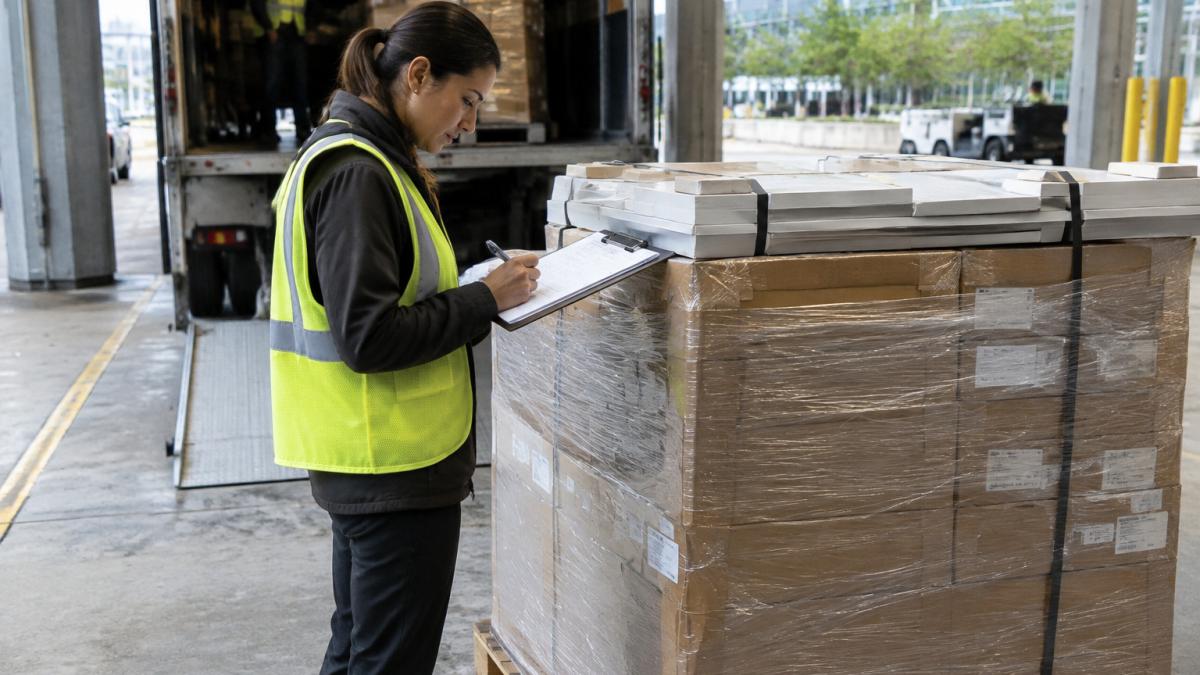
Set shipping checkpoints, not just tracking
A tracking number is not a plan. Build three checkpoints into your calendar:
- 72 hours before the in-hand date: confirm the package is in transit and moving, not just labeled.
- 48 hours before the in-hand date: if tracking shows no movement or an exception, call the carrier and the printer the same day and ask for a trace and an ETA.
- 24 hours before the in-hand date: confirm the delivery window with the carrier and the venue receiving contact, and confirm someone will be there to accept it.
Choose a carrier service that matches your margin. If you are choosing a sign type for an event, you can explore custom printing options and see the vinyl banner product options and how they are produced. Faster carrier services shorten the window for a missed delivery, while slower services leave less room for error. For high-value or oversized signs, ask whether the shipment can be split into two packages so a single lost box does not take the whole order down.
Confirm venue receiving rules before you ship
Venues differ widely in what they accept and when. Confirm these points in writing with the venue's event or operations contact:
- Receiving hours and days: many convention centers and hotels accept freight only during set business hours, and some do not accept weekend deliveries.
- Loading dock and access restrictions: dock height, freight elevator availability, and whether the venue requires a delivery appointment.
- Package size and weight limits: some venues cap pallet size or require liftgate service.
- Named recipient: the full name and phone number of the person who will sign for the delivery, plus a backup name.
- Storage: where the signs will be held between delivery and installation, and whether the venue charges storage fees.
- Direct-to-booth or direct-to-room delivery: whether the carrier can deliver to the installation location or must drop at the dock.
A sign delivered at 6 p.m. to a loading dock that closes at 5 p.m. waits until morning, and may miss your installation window.
Build a written contingency sequence
Decide in advance what happens if the shipment is late, lost, or damaged, and who has authority to trigger each step. A practical sequence:
- Trace and escalate: carrier trace plus vendor escalation the same day a checkpoint fails.
- Local backup print: identify a local printer near the venue that can produce a basic replacement from your print-ready file, and confirm its turnaround before the event.
- Local pickup: if the vendor has a facility or partner near the venue, ask whether you can arrange pickup instead of waiting on transit.
- Digital or temporary fallback: a tablet or monitor with the key message, or a generic pre-printed sign, can fill a gap while a replacement is produced.
Set a decision time, for example, 48 hours before installation, at which the team switches to the backup plan if tracking is not confirmed. Write the sequence down, name the decision-maker, and share it with the installation crew so no one is improvising on event day.
Watch out: a venue that accepts packages "before the event" may still require a delivery appointment and a certificate of insurance from the carrier, confirm both before the shipment leaves the printer.
Build a Backup Plan for Delayed Signage
Even careful planning can fail. A backup plan keeps the event running if signs arrive late or damaged.
Start with a short list of fallback options:
- Digital displays: a tablet or monitor with the key message can fill a gap
- Temporary printed signs: a local printer or office printer can make a basic sheet for emergencies
- Pre-printed generic signs: a simple welcome or directional sign that works without the custom design
- Repositioned messages: move a sign that did arrive to the most visible spot
Decide in advance who has authority to trigger the backup plan. Set a decision time, such as 48 hours before installation. If the sign is not in transit with tracking confirmed by then, switch to the fallback.
Use This Event Signage Checklist Before Your Order
Use this checklist before you place your order and again before installation.
- Event date, installation date and in-hand date recorded
- In-hand date set at least three to five business days before installation
- Print-ready artwork submitted in the printer's accepted format
- Proof approval deadline on the calendar
- Order cutoff time confirmed with the printer
- Written delivery confirmation received
- Guarantee terms, exclusions and claim window reviewed
- Carrier and tracking number shared with the team
- Venue receiving contact and hours confirmed
- Backup plan and decision time agreed
For turnaround needs that are tight, C3 DesignsBiz offers same-day printing options. Visit the C3 DesignsBiz website for current turnaround information and a quote for your project.
Frequently Asked Questions
How far in advance should I order event signage?
Order as early as your budget and design approvals allow, then work backward from the event date. Allow time for proof approval, production, shipping, and a buffer for delays. Order early enough to cover proof approval, production and shipping before your event. Ask your printer for their current production times and cutoff times before you set your own deadline.
How can I confirm a printer's delivery date before placing an order?
Ask the printer to state the in-hand date in your order confirmation, not just the production date. Confirm the order cutoff time, the proof approval deadline, and the shipping method. Ask whether the delivery date is guaranteed or an estimate, and what happens if it is missed. Get the answers in writing by email so you have a record if the timeline changes.
What should I do if my event signs are delayed?
Contact the printer right away and ask for the current status, a revised ship date, and tracking information. If the delay threatens the event, use your backup plan: a smaller set of printed signs, digital displays, or temporary paper signs that can be printed locally. Keep the design files ready so a replacement can be produced quickly. Document each conversation in writing in case you need to request a credit or refund.
Can event banners be printed and shipped in 24 hours?
Some printers offer 24-hour or same-day production for vinyl banners, but the total time also depends on shipping. A 24-hour print turnaround does not guarantee delivery within 24 hours. Confirm whether the quoted timeline includes shipping, what size and material are in stock, and whether your artwork needs changes before printing. For event dates that are close, plan for pickup or a local printer if the timeline is tight.
