
Last Updated: October 25, 2026
Quick Summary
Printivity alternatives for event planners are specialized printing vendors that offer faster turnarounds, better customization, clearer rush-timeline communication, and workflow integration optimized for coordinating multiple event deliverables like invitations, programs, signage, and badges on tight deadlines.
- Event planners need vendors offering same-day or next-day turnaround with transparent cut-off times and clear definitions of what same-day means.
- True in-hands dates include production, finishing, and shipping time, not just printing speed, so compare total landed cost across vendors using identical written specs.
- Large-format signage, custom invitations, and multi-product orders require vendors with variable turnaround times and the ability to sequence and coordinate shipments.
- Build a 5-10% quantity buffer into orders and approve artwork at least one business day before the vendor's cut-off to avoid missed deadlines.
- Request itemized quotes with setup fees, rush surcharges, finishing, proofing rounds, and shipping clearly separated so you can compare true total costs.
Table of Contents
- Why Event Planners Switch From Printivity
- Best Printing Services for Event Planners: What to Compare
- Rush Printing for Event Materials: Speed Without Sacrifice
- Custom Event Invitation Printing: Design, Proof, Deliver
- Event Poster and Banner Printing: Large-Format Options
- Total Cost and Quote Transparency Across Vendors
- Getting Your Event Materials Right the First Time
- Frequently Asked Questions
Why Event Planners Switch From Printivity
Event planners outgrow general-purpose printing platforms when they need faster turnarounds, better customization, or more control over their event materials workflow.
The issue isn't that Printivity is bad, it's that event planners need vendors who understand their constraints.
Planners switch to vendors offering same-day custom design, faster proofs, clearer rush-timeline communication, and better workflow integration. The printivity alternatives here address those pain points.
Best Printing Services for Event Planners: What to Compare
Choosing the right printivity alternative means evaluating vendors on what matters to event professionals: not just speed, but clarity on what "rush" means, how customization works, and whether delivery promises hold when your event is 48 hours away.
When comparing printing services for events, focus on these core dimensions:
- Turnaround time transparency: Does the vendor guarantee same-day or next-day turnaround, or is it "best effort"? What happens if they miss the deadline?
- Customization and design: Can they handle your custom files, or do they offer design services if you need help?
- Proofing process: How many proof rounds are included? Can you request changes without losing your timeline?
Rush Printing for Event Materials: Speed Without Sacrifice
Rush printing is a promise, not a guarantee. What separates vendors that deliver from those that overpromise is production workflow and how they handle demand spikes.
True same-day or next-day turnaround requires in-house production capacity, a clear order cut-off, and honest communication about what "same-day" means. Some vendors print fast but charge extra for overnight shipping or can't guarantee brand color matching, know which trade-offs you're making.
What "Same-Day" Actually Means
A same-day claim is only meaningful when it is tied to a cut-off time and a definition of completion. Ask each vendor to state, in writing:
- The order cut-off for same-day production (for example, artwork approved by a specific morning hour).
- Whether "same-day" means printed, shipped, or delivered. Printed and sitting in a facility is not the same as delivered to your venue.
- Whether the clock starts at order placement or at proof approval. Most production schedules start at approval, not at order.
A vendor that cannot answer these four questions precisely is offering a marketing claim, not a service level.
The Timeline Model: Production Plus Transit
Planners often mistake production time for delivery time. The real in-hands date is the sum of several stages, each of which can slip:
| Stage | Typical range | What can go wrong |
|---|---|---|
| Artwork prep and file check | Hours to 1 day | Missing bleeds, low-resolution images, wrong color mode |
| Proofing and approval | Hours to 2 days | Extra revision rounds, slow internal sign-off |
| Production | 1-3 days standard; same-day or next-day rush | Queue spikes, equipment downtime, stock shortages |
| Finishing | Same day to 1 day | Grommets, binding, folding add a step after printing |
| Shipping | 1-5 days depending on method and distance | Carrier delays, weather, wrong address, signature issues |
Add those stages up and a job "printed in 24 hours" can still take three to five days to reach the venue, which is why the in-hands date, not the production date, belongs on the quote.
Sequencing Multi-Product Orders
Rush printing gets complicated when you need multiple products coordinated: if invitations print in 24 hours but banners take 3 days, you're not ready. The best printivity alternatives for events handle this by:
- Offering variable turnaround times for different products so you can sequence orders strategically
- Providing clear timelines upfront: "Invitations: 24 hours, banners: 2 days, programs: 1 day"
- Building in buffer time so they rarely miss deadlines
Order longest-lead items first (large-format signage, special finishing), then programs and badges, then invitations. If one vendor runs all of them, ask whether the jobs can ship together in one delivery.
Proofing Buffers and Deadline Risk
The most common cause of a missed event deadline isn't slow printing, it's late proof approval. Build a buffer into your schedule:
- Approve artwork at least one business day before the vendor's cut-off, not on the cut-off.
- Request a physical proof for anything color-critical and allow time for it to arrive and be reviewed.
- Set an internal sign-off deadline earlier than the vendor's, so a slow stakeholder does not consume your production window.
SGIA (Specialty Graphic Imaging Association) guidelines on rush production best practices outline industry standards for turnaround claims. Reputable vendors follow these standards or exceed them.
C3 DesignsBiz specializes in same-day custom design and printing for event materials, critical when your event is 36 hours away and you need custom vinyl banners with brand color matching. Ask for the cut-off time and in-hands date in writing.
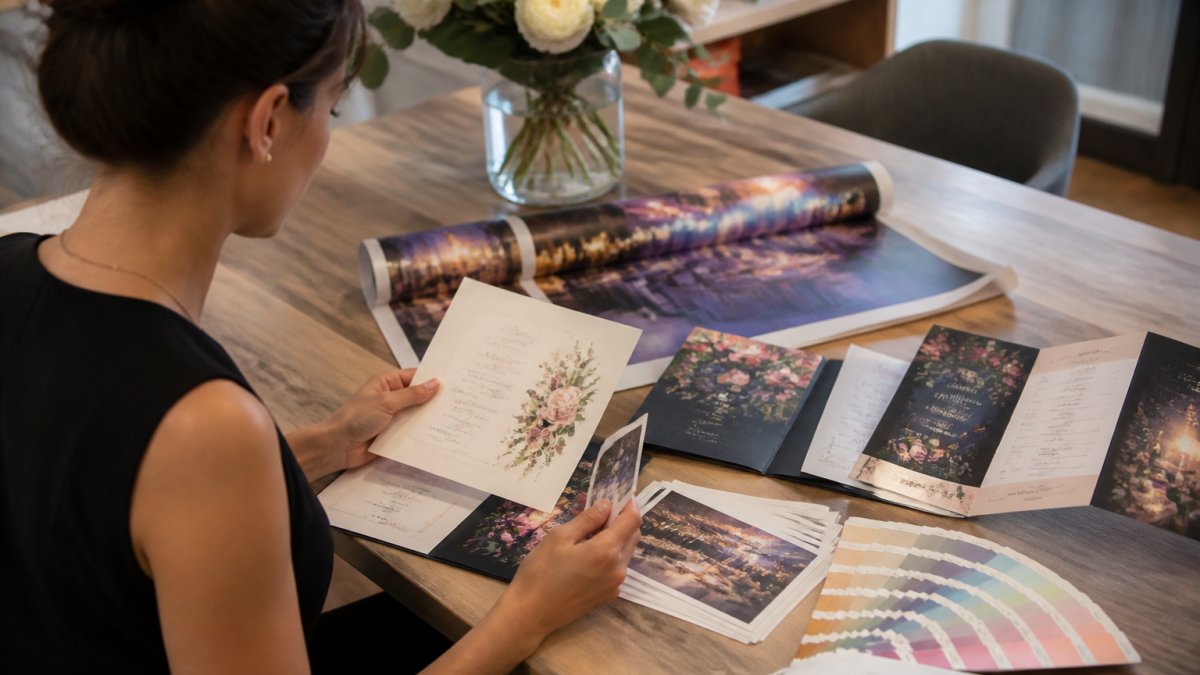
Custom Event Invitation Printing: Design, Proof, Deliver
Invitations set the tone for your event and carry your brand identity, and generic printing services treat them like any other product.
The workflow should be: you provide concept or files, the vendor proofs quickly (hours, not days), you request changes, and they reprint without losing your timeline.
When evaluating custom invitation printing, ask:
- How many proof rounds are included before you're charged for revisions?
- Can they handle variable data printing if you need personalized names or addresses?
- What file formats do they accept, and do they catch file errors before printing?
C3 DesignsBiz offers custom design alongside printing, so you can hand off a rough concept and get a finished product without managing multiple vendors.
The Printing Industries of America resources on print file preparation provide technical guidance on file setup, but a good vendor should catch these issues themselves and alert you before printing.
Event Poster and Banner Printing: Large-Format Options
Large-format signage is where printivity alternatives really differentiate.
For event posters and banners, the key variables are:
- Material choice: Vinyl, canvas, mesh, or paper? Each has different durability and appearance trade-offs.
- Finishing: Do you need grommets, hemming, or mounting hardware included?
- Size flexibility: Can they handle custom dimensions, or are you locked into standard sizes?
American Advertising Federation standards on outdoor advertising materials outline best practices for banner durability and visibility, though most professional printers follow these standards automatically.
You can explore custom printing options and request a quote from C3 DesignsBiz for large-format event materials like vinyl banners and backdrops. The turnaround for large-format work depends on size and material.
Total Cost and Quote Transparency Across Vendors
Many event planners get frustrated here: you request a quote, get a number that doesn't match expectations, then discover hidden setup, rush, shipping, design, or finishing charges. Stop comparing advertised unit prices and start comparing total landed cost for a defined scenario.
Transparent vendors break down their pricing like this:
| Component | Cost Impact | Notes |
|---|---|---|
| Unit cost (base) | Decreases with volume | 500 units = lower per-unit cost than 100 |
| Rush surcharge | 15-30% premium | Same-day or next-day turnarounds cost more |
| Design services | Hourly or flat fee | Usually waived if you provide print-ready files |
| Proofing rounds | Included (1-3) | Additional rounds may incur charges |
| Finishing (grommets, etc.) | Per-item add-on | Vinyl banners need grommets; programs need binding |
| Shipping | Weight and distance based | Can be significant for large orders |
| Setup/art fees | One-time charge | Waived by some vendors for repeat orders |
How to Build a Comparable Quote
The only reliable way to compare printivity alternatives is to send every vendor the same written spec and ask for the same line items back. Include:
- Product and dimensions: exact size in inches, not "standard poster."
- Quantity: the real count plus a stated overage (see below).
- Stock and weight: paper type and pound/point weight, or substrate for signage.
Ask each vendor to return a single total with every line itemized. A vendor that will only quote a unit price is telling you the rest of the cost will appear later.
Worked Scenario: Comparing Three Jobs
Prices vary by vendor, spec, and date, so run the same three scenarios through every candidate and compare totals side by side. The numbers below are placeholders, replace them with your quotes, but the structure exposes the real differences.
| Line item | Job A: 250 invitations | Job B: 500 programs | Job C: two 8x10 vinyl banners |
|---|---|---|---|
| Base unit cost | $____ x 250 | $____ x 500 | $____ x 2 |
| Setup / art fee | $____ | $____ | $____ |
| Design service | $____ (or $0 if print-ready) | $____ | $____ |
| Proofing | $____ | $____ | $____ |
| Finishing | $____ (envelopes, etc.) | $____ (binding) | $____ (grommets/hem) |
| Rush surcharge | $____ | $____ | $____ |
| Shipping | $____ | $____ | $____ |
| Total landed cost | $____ | $____ | $____ |
| Cost per unit | $____ | $____ | $____ |
Run this for two or three vendors and a pattern emerges: one wins on small-quantity invitations, another on high-volume programs, a third on large-format because it bundles finishing and shipping. A single "cheapest vendor" answer rarely holds across every deliverable.
The Quantity Break Trap
Unit prices drop at quantity thresholds, but not linearly and not always where you expect, the per-unit price often falls sharply between the smallest run and the next standard run, then flattens. Two consequences for planners:
- Rounding up can be cheaper than ordering exact. If you need 180 programs and the next break is at 250, the 250-run total may be close to the 180-run total while giving you spares for VIPs, press, and replacements.
- Splitting a job can cost more than combining it. Ordering invitations and programs from the same vendor in one purchase order often avoids a second setup fee and a second shipping charge. Ask explicitly whether combining jobs reduces either.
Overage, Waste, and the Real Unit Count
Print runs produce waste, and events consume more than headcount suggests: speakers, sponsors, venue staff, press, and replacements. A common buffer is 5-10% above expected attendance, slightly more for heavily handled pieces like programs and badges. Build it into the quote, a second rush order almost always costs more per unit than the buffer would have.
Reading the Fine Print on a Quote
Before you approve, confirm these in writing:
- What triggers a reprint charge and who pays when the error is the vendor's.
- Whether the quoted price holds if your quantity or in-hands date changes after approval.
- Whether shipping is estimated or locked, and what happens if the carrier misses the delivery window.
You can request a custom printing quote from C3 DesignsBiz for your specific project. Provide your quantities, delivery timeline, and product types, and you'll get a clear, itemized quote with no surprises.
Getting Your Event Materials Right the First Time
The costliest mistake in event printing is ordering something wrong, realizing it too late, and either living with substandard materials or paying rush fees for a reprint, usually the result of communication breakdowns with the vendor.
Protect yourself by:
- Providing print-ready files or working with the vendor's design team early: Don't wait until two days before your event to start the design process.
- Requesting a physical proof, not just a digital one: Colors look different on screen versus in print. A physical sample prevents color-matching disasters.
- Clarifying what happens if something goes wrong: Does the vendor reprint at no cost if it's their error? What's the process?
Event planners who switch from Printivity to specialized printivity alternatives cite better communication and fewer surprises as the top reason they stay: they know exactly what they're getting, when, and at what cost.
The difference between a printing vendor and a true event printing partner is responsiveness and reliability under pressure. C3 DesignsBiz combines same-day custom design, fast nationwide turnaround, and premium quality. Explore custom printing options and request a quote from C3 DesignsBiz to see how we handle your next event.
Frequently Asked Questions
What should event planners compare when choosing a printing service?
Prioritize turnaround time, quality guarantees, customization depth, and proofing workflows. Check whether the vendor handles design or requires finished files, offers variable data printing for personalized tickets or name badges, and provides clear SLAs for rush orders. Ask about file setup support and reprint policies if mistakes occur, this protects your timeline and budget when deadlines are tight.
Which printivity alternative works best for custom event invitation printing?
Look for vendors offering variable data printing, which personalizes each invitation with attendee names or custom details. Confirm they accept common design formats (PDF, AI, EPS) and provide detailed proofs before production. Verify turnaround time matches your event date. Check whether they handle specialty finishes like foil stamping or die-cutting if your brand requires premium touches.
How can event planners avoid delays with rush printing?
Submit final design files at least 24-48 hours before your target delivery date, even for same-day services. Confirm file specifications (resolution, color mode, bleed) with your vendor before uploading. Build a 2-3 day buffer into your timeline for proofing and revisions. Track shipment status actively and have a backup vendor identified if your primary choice cannot meet the deadline. Clear communication about exact quantities and delivery address prevents last-minute surprises.
Can printing services handle custom event tickets and signage?
Yes. Most rush printing vendors offer event tickets with variable data printing, sequential numbering, and tear-off stub options. Large-format signage (banners, backdrops, posters) is widely available through digital printing and vinyl cutting. Confirm the vendor's maximum print size, material options (vinyl, canvas, foam board), and finishing capabilities (grommets, stands, lamination). Request samples of previous event work to verify color accuracy and durability.
