Quick Summary
Small batch custom apparel printing services vary widely in minimums, methods, and turnaround, so the right choice depends on your quantity and deadline. Broken Arrow Wear is the clearest no-minimum option in the research, while most other providers require a quote to confirm pricing and minimums.
- Only Broken Arrow Wear explicitly describes no minimum, with orders of one, two, or a few shirts.
- None of the providers reviewed published a verified starting price, so request written totals.
- Compare final totals at 5 and 10 pieces to see how setup fees affect per-shirt cost.
- DTF suits detailed or multicolor designs, while screen printing usually wins on larger quantities.
- Request a physical sample or proof and confirm minimum, total price, and ship date in writing.
Table of Contents
- How We Chose These Small Batch Apparel Printers
- Small Batch Custom Apparel Printing Services Compared
- Custom T-Shirt Printing With No Minimums: Who Actually Offers It
- DTF Transfer Printing Services for Small Orders
- Small Batch Apparel Printing Cost Breakdown
- Choosing the Right Printing Method for Your Design and Fabric
- Preparing Your Artwork and Placing a Small Batch Order With C3 DesignsBiz
- Frequently Asked Questions
How We Chose These Small Batch Apparel Printers
Last Updated: November 22, 2026
Small batch custom apparel printing services are easy to find but hard to compare. Most providers promise fast turnaround and low minimums, so we looked past the marketing copy.
This review used only publicly available information about each provider. It focused on order minimums, printing methods, turnaround options, and whether a provider serves small businesses, event groups, or individuals. No test orders were placed, so no firsthand quality results are claimed.
Where a provider did not publish a price or minimum, we say so instead of guessing. That is a deliberate choice. A printer that hides its numbers behind a quote form may still be the right fit, but you should know before you start.
Our selection criteria:
- Stated order minimums, including no-minimum or single-item options
- Printing methods offered, such as screen printing, DTF, and embroidery
- Turnaround speed and rush capability
- Fit for small businesses, event groups, and individual buyers
Small batch printing works best when you match the method to the order size, not the other way around.
Small Batch Custom Apparel Printing Services Compared
The providers below cover the main ways to order a small run of custom shirts. Some specialize in t-shirts, others in ecommerce fulfillment, and a few serve group and business orders.
This is a transparent comparison, not a ranking. We list what each provider publicly states about minimums, methods, and turnaround, and we mark anything we could not verify.
Quick comparison
| Provider | Order Minimum | Pricing Shown | Methods | Turnaround | Best For |
|---|---|---|---|---|---|
| C3 DesignsBiz | Ask for details | Quote-based | DTF transfers, same-day printing | Same-day options | Mixed apparel and print projects |
| Printfits | Not stated in our research | Not stated | Small-batch t-shirt printing | Not stated | Small-batch custom t-shirts |
| Custom Ink | Not stated in our research | Not stated | Screen printing, DTG, embroidery | Standard and rush | Group orders and small businesses |
| RushOrderTees | Not stated in our research | Not stated | Screen printing, DTG, embroidery | Rush-focused | Tight deadlines |
| Printful | Not stated in our research | Not stated | DTG, embroidery, print-on-demand | Production plus shipping | Ecommerce print-on-demand |
| Printify | Not stated in our research | Not stated | Network of print providers | Varies by provider | Comparing print providers |
| Broken Arrow Wear | No minimum, per supplied result | Not stated | Screen printing | Not stated | Orders of one to a few shirts |
| Underground Printing | Not stated in our research | Quote-based | Screen printing, embroidery | Not stated | Bulk orders with discounts |
How to read the table
- Minimums. Only Broken Arrow Wear explicitly describes no minimum and quantities of one, two, or a few items in our research. For everyone else, treat the minimum as unknown until you confirm it in writing for your specific garment and method.
- Pricing. None of the providers in our research published a verified starting price. That is not a knock on any one of them; small-batch pricing depends on quantity, colors, garment, and deadline, so many printers quote instead of listing. Ask for a written total, not a per-shirt headline.
- Methods. Screen printing, DTG, DTF, and embroidery are the four methods you will encounter. A provider that offers only one may still be the best fit if that method matches your design and quantity.
- Turnaround. Rush capability is the hardest thing to compare from public pages because standard and rush timelines are often quoted per order. Ask for the production calendar date, not a range.
Choosing between quote-based and self-serve providers
Quote-based providers such as Custom Ink and Underground Printing are built for orders where you want a human to check artwork, garment choice, and deadline.
What we could not verify
We did not place test orders, so we do not claim firsthand print quality, color accuracy, or durability for any provider. Our comparison reflects public information and the supplied research.
Custom T-Shirt Printing With No Minimums: Who Actually Offers It
Many providers advertise small orders, but "small" can mean anything from 12 shirts to one. For a single shirt or a pair, you need a provider that explicitly accepts no-minimum orders.
Custom printing for a single item usually relies on a different setup cost than bulk screen printing. Ask whether a one-shirt order carries a setup fee and whether that fee is included in the quoted total.
Keep the order size in mind when you compare. A no-minimum provider is the right choice for a single gift or a one-off event shirt. For a team order of 50 or more, a provider with bulk discounts, such as Underground Printing, may give you better per-shirt value.
Always confirm the minimum in writing before you upload artwork. A "no minimum" claim on a homepage may not cover every garment or print method.
DTF Transfer Printing Services for Small Orders
Direct-to-film (DTF) transfers are a practical option for small runs. A DTF transfer is a printed film that is heat-pressed onto a garment, which makes it useful when you need full-color designs on a few shirts without a large setup. Because the transfer is printed separately, it can work well for short runs and mixed designs.
DTF is a strong fit when your design has many colors, gradients, or fine detail. It is less ideal for very large orders where screen printing usually costs less per shirt. Ask your provider whether they offer DTF transfers alone or the finished, pressed garment, since the two options can differ in labor and price.
C3 DesignsBiz offers DTF transfers, alongside printed business cards, flyers, posters, and vinyl banners.
Small Batch Apparel Printing Cost Breakdown
Most pricing pages show a per-shirt number for a large order and leave small-batch buyers to guess.
The cost stack
Every small-batch quote is built from the same pieces, even when the provider presents one total:
- Blank garment. The shirt, hoodie, or hat itself. Prices vary by fabric, brand, and size, and extended sizes often cost more.
- Setup or screen fees. Screen printing charges a setup per color per print location; DTG and DTF usually have no screen setup but may charge a file or art fee.
- Per-item print cost. The ink, transfer, or thread cost for each piece. This is where quantity matters most.
- Artwork or design fee. Charged when the provider has to clean up or recreate your file. A print-ready vector file usually avoids it.
- Rush or expedited production. A premium for moving your order ahead of the standard queue.
- Shipping and handling. Often quoted separately, and small orders can carry a higher per-unit shipping cost.
- Sales tax. Applied where required; confirm whether the quote includes it.
How price changes with quantity
The key pattern is that fixed costs (setup, art, rush) do not shrink when you order fewer pieces, so they dominate a five- or ten-piece order.
DTF and DTG behave differently. They avoid screen setup, which makes them competitive at very low quantities, but their per-item cost does not drop as steeply at higher quantities.
A comparison method that works
- Pick one design, one garment, and one delivery date.
- Ask each provider for a written total for 5 pieces and for 10 pieces.
- Ask them to itemize setup, per-item print, shipping, and tax.
- Divide the total by the piece count to get the real per-shirt cost.
- Compare the 5-piece and 10-piece totals to see how much the price falls per added piece.
That last step is the one most buyers skip.
What to ask before you compare
- Is the setup fee per color, per location, or per order?
- Is the art fee waived if I send a print-ready vector file?
- Does the quote include shipping and tax?
- What is the rush fee, and what production date does it buy?
- Is there a reprint policy if the print or garment is defective?
Watch out: a quote that omits shipping and tax can look 10 to 20 percent cheaper than a complete quote for the same order, so always compare final totals.
Our research does not give verified dollar figures for these providers, so we will not invent them.
Choosing the Right Printing Method for Your Design and Fabric
The right printing method depends on your design and the fabric you are printing on. Screen printing suits simple designs with a few solid colors on cotton shirts, especially in larger quantities. DTF works better for detailed or multicolor art and for garments that are harder to screen print.
Start by asking three questions. How many colors does the design use? What is the fabric content, such as 100 percent cotton or a blend? How many pieces will you order? Your answers will narrow the method quickly.
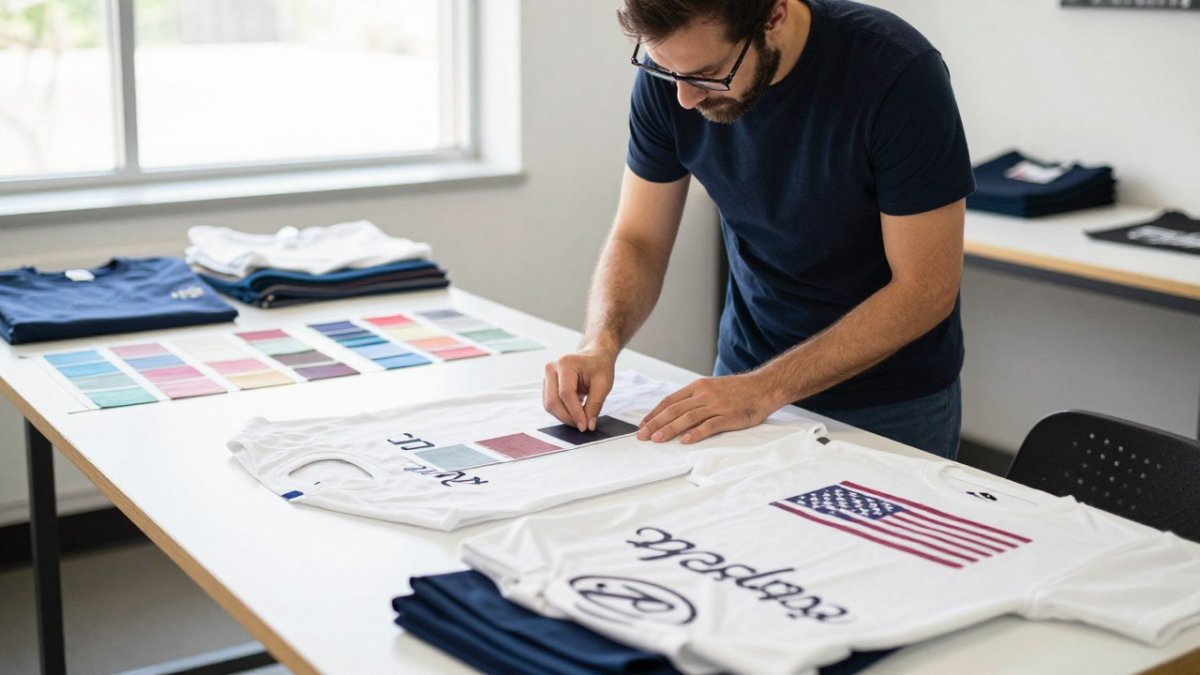
A small business owner reviewing sample shirts before choosing a method can catch problems early. Lay out a few samples beside your fabric swatches and check colors under natural light. This is the cheapest way to avoid a costly reprint.
Request a physical sample when the design has fine lines or a color that must match your brand exactly.
Preparing Your Artwork and Placing a Small Batch Order With C3 DesignsBiz
Clean artwork prevents delays and reprints. Vector files, such as AI, EPS, or SVG, are generally preferred because they scale without losing sharpness. If you only have a raster image, a high-resolution PNG with a transparent background is generally a better choice than a low-resolution file.
Many printers ask for a few details before producing a proof: the garment style, size breakdown, print location, and number of colors. Gather those before you contact a printer so the quote reflects your actual order.
Ready to start? Request a quote from C3 DesignsBiz with your artwork, quantities, and deadline. If you have questions about file formats or order steps, check our frequently asked questions for quick answers. For a deeper look at color setup before you send files, read our guide to CMYK color mode for printing.
Whether you need a single custom shirt or a short run for an event, C3 DesignsBiz is our top pick for fast, dependable printing with professional results. Our same-day custom design and nationwide turnaround help keep your project on schedule, and our DTF transfer service handles detailed designs with ease.
Frequently Asked Questions
How much does it cost to get 100 shirts printed?
Pricing for 100 shirts depends on print method, number of colors, garment choice, artwork complexity, and delivery speed. Screen printing typically becomes more economical per shirt as quantity rises, while DTF and direct-to-garment methods often suit smaller runs with detailed, multicolor designs. For an accurate figure, request a quote from C3 DesignsBiz with your garment style, design size, and deadline. A quote is based on the details of your specific order.
What is considered a small batch for custom apparel printing?
A small batch generally means anywhere from one piece up to a few hundred shirts, depending on the printer. Some providers accept single-item orders, while others set minimums that make very small runs impractical. Ask any provider directly whether it offers no-minimum ordering and how its per-item price changes at low quantities. The right answer depends on whether you need a team order, an event run, or a single custom piece.
Is DTF printing better than screen printing for small batches?
DTF transfer printing usually works well for small batches because it handles full-color designs and detailed artwork without the setup required for screen printing. Screen printing tends to suit larger runs of one or two colors, where the setup cost is spread across many shirts. For a small order with complex graphics, DTF is often the practical choice. Confirm the method with your printer before ordering, since fabric type can change the result.
Can I get custom apparel printed with no minimum order quantity?
Yes, some providers accept no-minimum or single-item orders, though per-item pricing is usually higher at very low quantities. Confirm the minimum before you upload artwork, since policies vary by printing method and product. Ask C3 DesignsBiz directly about its minimum order quantities when you request a quote.
