
Last Updated: November 2, 2026
Quick Summary
Small batch printing can be cheaper overall because you spend less money up front and waste less stock. A large run may have a lower cost per piece, but you pay for all of it at once, and any copies that go unused, outdated or damaged raise the real cost.
- Compare total spend and cost per piece you actually distribute, not just the per-piece price.
- Setup and prepress fees are fixed, so they weigh heavily on small orders but spread thin on large ones.
- Storage, spoilage, obsolescence and tied-up cash can make a large run cost more in total.
- Smaller runs usually win when your details change often or you are testing a message.
- Ask printers for setup fees and run costs as separate line items at several quantities to compare.
Table of Contents
- Why Lower Per-Unit Pricing Doesn't Always Mean Lower Total Spend
- How Print Quantity Changes Cost Per Item
- Small-Run Printing Costs: A Worked Example in USD
- Small Batch vs. Bulk Printing: When Smaller Runs Win
- DTF Printing for Small Orders and Digital vs. Offset Options
- How to Reduce Printing Costs Without Overordering
- Requesting Comparable Quotes for Your Next Print Run
- Frequently Asked Questions
Why Lower Per-Unit Pricing Doesn't Always Mean Lower Total Spend
Small batch printing can be cheaper overall because you spend less money up front and may waste less paper. Many people see a lower price per piece on a big run and assume it saves money. The real question is how much you spend in total, and whether you will use every piece before the content goes out of date. Refining your production strategy by reducing printing waste ensures that every batch remains profitable while preventing the accumulation of obsolete inventory.
Here is the trap. A large run looks cheap on a per-piece basis, but you pay for all of it at once. If half the flyers end up in a closet with an old address or an expired offer, that per-piece price was not a bargain.
Compare the two numbers:
- Cost per piece: what each item costs
- Total spend: what you pay for the whole order
- Usable spend: the share of the order you actually put in front of customers
A smaller order can cost more per piece and still cost less overall, especially when much of the big run would sit unused.
How Print Quantity Changes Cost Per Item
Print quantity changes the cost of each piece because some costs are fixed. The printer has to set up the job before the first sheet runs, and that setup cost does not change with the size of the order.
Spread a fixed setup cost over 100 pieces and each one carries a heavy share. Spread it over 5,000 pieces and the share per piece drops fast. That is why bulk pricing looks so good on paper.
Setup and prepress costs
Setup and prepress work includes file checks, color proofs, plate or screen preparation, and machine calibration. These steps take time whether you order 50 pieces or 5,000.
Small batches carry the same prep work, so the setup cost matters more in each piece. Ask your printer to break the quote into setup and run costs. That lets you see exactly what you are paying for.
Economies of scale and volume discounts
Economies of scale mean each extra piece costs less to produce once the job is running. Printers also offer volume discounts on paper and ink when they buy in bulk.
These savings are real, but they only help if you need the volume. A discount on 2,000 cards you will never hand out is not a discount at all.
Small-Run Printing Costs: A Worked Example in USD
The fastest way to see why a small batch can cost less overall is to put real numbers on the page. The figures below are purely illustrative and are not C3 DesignsBiz prices. Actual pricing depends on quantity, dates, and delivery, so request a quote for current prices.
Consider a hypothetical 4-page, full-color flyer with a simple fold. A printer's quote typically breaks out a setup and prepress fee, then a run cost that changes with volume:
| Quantity | Setup and prepress | Run cost per piece | Total spend | Cost per piece |
|---|---|---|---|---|
| 250 | $75 | $0.42 | $180.00 | $0.72 |
| 500 | $75 | $0.31 | $230.00 | $0.46 |
| 1,000 | $75 | $0.22 | $295.00 | $0.30 |
| 2,500 | $75 | $0.14 | $425.00 | $0.17 |
| 5,000 | $75 | $0.10 | $575.00 | $0.12 |
In general, moving from a smaller to a larger order lowers the cost per piece while raising total spend, because setup costs are spread over more pieces.
The number that actually decides the question is how many pieces you will use. If you can distribute fewer pieces than you order, the cost per used piece rises, so a larger run can end up costing more per piece you actually put to work.
Use this formula with your own quotes:
- Total spend = setup fee + (run cost per piece × quantity)
- Cost per used piece = total spend ÷ pieces you actually distribute
- Break-even quantity = the order size where cost per used piece stops falling because you can no longer distribute the extras
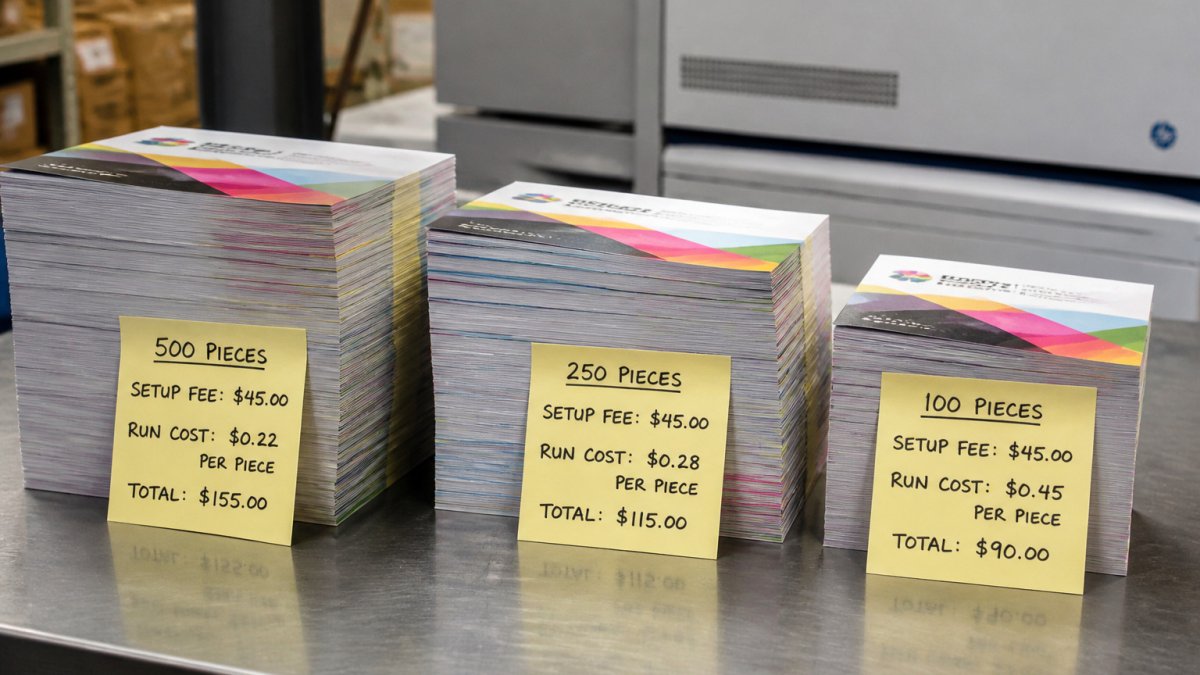
Many print products carry a fixed prepress or setup component, which is why the per-piece price and the total spend can point in opposite directions.
Small Batch vs. Bulk Printing: When Smaller Runs Win
Unit price is only one line in the ledger. The honest comparison is total cost of ownership: what you pay for the print, plus what you pay to hold it, plus what you lose when some of it goes unused. Once you add those lines, small batches win more often than the per-piece price suggests.
Quotes often leave out the costs of holding stock, such as shelf space, boxes, and handling, along with the share of a large run that may be spoiled, damaged, or outdated before use.
| Cost line | 1,000-piece run | 5,000-piece run |
|---|---|---|
| Print spend | $295.00 | $575.00 |
| Storage for 12 months | $240.00 | $1,200.00 |
| Spoilage, damage, obsolescence (15%) | $44.25 | $86.25 |
| Cash tied up (opportunity cost) | Low | High |
| Disposal of unused stock | Minimal | $30-$60 |
| Effective total cost | ~$579 | ~$1,891 |
A larger order may still have a lower cost per piece, but its effective total cost can be considerably higher once holding costs and unused stock are counted, and that gap widens the longer stock sits and the more often your offer, pricing, or contact details change.
Smaller runs tend to win when any of these are true:
- Your details change often. Prices, dates, addresses, and promotions can turn a large stack into recycling faster than you can distribute it.
- You are testing a message. A short run lets you measure response before committing to thousands of pieces; a reprint with the winning version is cheaper than a warehouse of the losing one.
- You need materials for one event. A trade show, client meeting, or seasonal push may need only a few hundred pieces.
- Storage is limited or costly. Shelf space, boxes, and handling are real expenses, and printed stock can warp, fade, or get damaged in storage.
- Cash flow is tight. Money spent on inventory is money not available for marketing, staff, or product.
Bulk runs make more sense when your message is stable, you will distribute the full quantity within a few months, and you have room to store it without damage. A useful rule of thumb: if you cannot confidently distribute the order within 90 days, price the smaller run and compare effective total cost, not sticker price.
DTF Printing for Small Orders and Digital vs. Offset Options
Two print methods shape how small orders are priced: digital and offset. Digital printing generally needs less setup, so it often suits short runs. Offset printing generally has higher setup costs but can offer lower costs per piece on large runs.
For small orders, digital printing often keeps total spend lower. That is the main reason small-batch work usually goes digital.
Ask any printer which method they recommend for your quantity. A good answer will explain the trade-off in plain terms.
How to Reduce Printing Costs Without Overordering
You can keep costs down without ordering too much. Try these steps:
- Order only what you can distribute within a few months
- Keep your design flexible so you can reorder with small changes
- Combine similar jobs into one order when the content matches
- Ask for a quote at two or three quantities and compare total spend
- Check your artwork before submitting, since file errors can add delays and reprint costs, and learn what CMYK color mode for printing is to prep print-ready files that match your brand.
Overordering is the most common way printing budgets go to waste. A small reorder is usually cheaper than throwing away a large stack.
Requesting Comparable Quotes for Your Next Print Run
When you get quotes, ask every printer for the same details so you can compare them fairly:
- The same quantity
- The same size, paper, and finish
- The same turnaround time
- A breakdown of setup fees and run costs
- Delivery costs
Once the quotes match, compare total spend and cost per piece you will actually use. The cheapest per-piece price is not always the best deal.
For current prices and a quote built around your artwork, quantities, and deadline, visit C3 DesignsBiz and submit your project details. Pricing depends on quantity, dates, and delivery.
Frequently Asked Questions
Why can small-batch printing be cheaper than bulk printing?
Small batches can cost less in total because you pay for fewer pieces, spend less on storage, and avoid throwing away outdated materials. A bulk run may lower the price per piece, but if you only use part of it before your event, branding or pricing changes, the leftover stock is wasted money. The lower unit price only helps when you actually use the full quantity. For urgent trade shows or client meetings, ordering what you need now often produces the lower total spend.
How do setup fees affect small-run printing costs?
Setup and prepress costs cover file preparation, proofing, and press or printer preparation. These costs are mostly fixed, so they are spread across the number of pieces in the run. On a small run, each piece absorbs a larger share of the setup fee, which raises the cost per item. Ask any printer to show setup fees separately from production costs so you can compare quotes accurately, and confirm whether the fee applies to reprints.
What is the most affordable printing method for a small apparel order?
For small apparel orders, DTF (direct-to-film) transfers are one option to consider when comparing methods. The file must be prepared correctly before printing, so send print-ready artwork in the format the printer requests. Pricing depends on quantity, design size, colors, and turnaround time, so request a quote from C3 DesignsBiz for current pricing rather than relying on estimates.
How can I reduce the cost of a small printing order?
Start by confirming that your file is print-ready so you avoid reprints and correction fees. Order only the quantity you will use within a realistic timeframe, and consolidate multiple projects into one order where the design allows. Ask for a quote that breaks out setup, production, and delivery so you can see where the money goes. Planning ahead can help you avoid rush fees.
