
Table of Contents
- The Real Cost Gap: Professional Printing vs. Home Printing Cost
- Print Shop Pricing Factors: What Goes Into Every Quote
- Color Printing, Proofing, and Quality Control: Costs Home Printers Can't Match
- Large-Format Printing Cost: Why Banners, Backdrops, and Signage Carry a Premium
- How to Save Money on Printing Without Sacrificing Quality
- When Professional Printing Is Worth the Extra Cost (And When It Isn't)
- Frequently Asked Questions
Last Updated: October 16, 2026
The Real Cost Gap: Professional Printing vs. Home Printing Cost
Walk into any print shop and you'll see machines worth more than a house. That's the first clue about why professional print shops cost more than the printer sitting in your spare room.
At C3 DesignsBiz, we field this question daily from marketing managers and event planners comparing quotes. The honest answer: home printing and professional printing solve different problems. A home printer handles a handful of pages. A commercial press handles thousands, with color that matches your brand every single time.
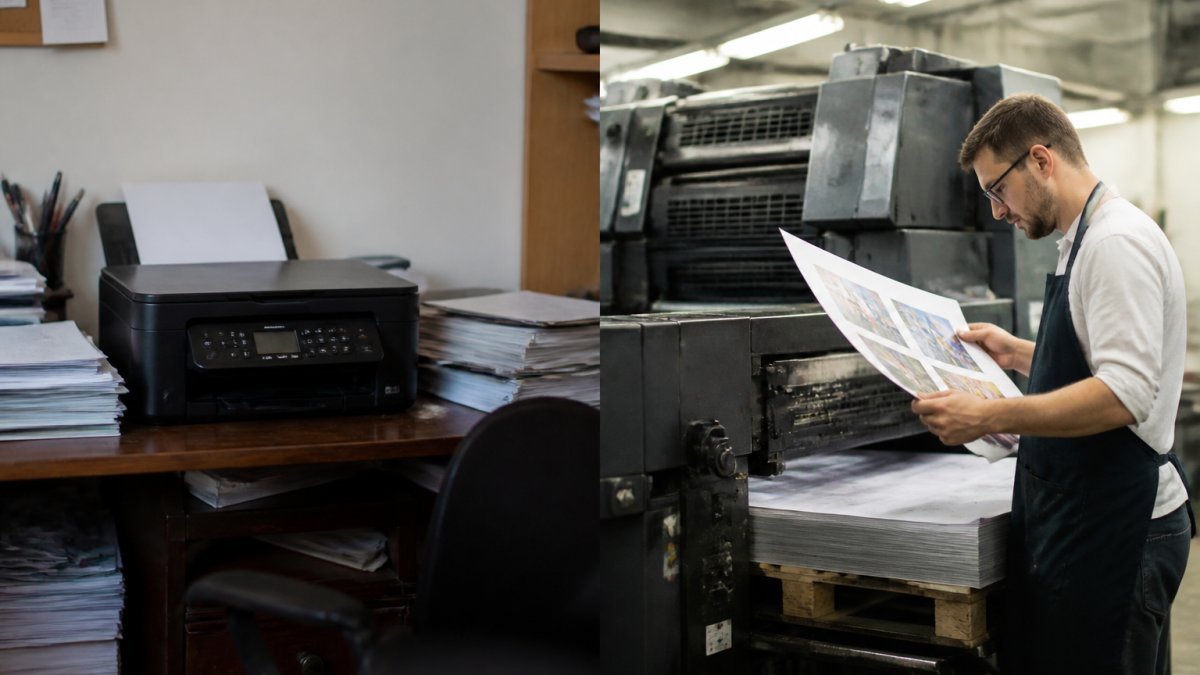
Professional printing is the production of marketing materials, signage, and branded items using commercial-grade equipment, trained operators, and quality control systems. Home printing uses a consumer desktop printer for low-volume, personal documents.
The gap comes down to what you're buying:
- Industrial equipment and its upkeep
- Bulk materials at wholesale rates
- Skilled labor and quality checks
- Finishing services like cutting, folding, and binding
Home printing wins on convenience for small jobs. Professional printing wins when quantity, color accuracy, and turnaround matter.
Print Shop Pricing Factors: What Goes Into Every Quote
Every professional print quote breaks into six cost buckets. Understanding them helps you compare bids fairly instead of guessing, and it lets you see which line items you can actually influence.
1. Setup and Prepress
Before a single sheet runs, the job has to be prepared. That means file checks, color conversion, imposition (arranging pages on a press sheet), and on an offset press, making plates. Setup is largely a fixed cost, so it hurts small runs the most: the same setup that costs pennies per unit across 5,000 brochures can dominate the price of 50.
2. Materials
Paper, cardstock, vinyl, canvas, and specialty stocks are priced per sheet or per square foot, and the price changes with weight, coating, and finish. A shop buys at wholesale, but it still passes material cost through, and material is often the single largest line on a large-format quote.
3. Ink and Toner
Ink and toner scale with coverage, not just page count. A full-bleed photo poster uses far more ink than a text-heavy flyer of the same size. This is why two jobs with identical dimensions can quote very differently.
4. Labor
Operators run the press, inspect output, and handle finishing. Labor is billed by time, so jobs that need more passes, more color adjustments, or more hand work cost more.
5. Finishing
Cutting, folding, scoring, binding, laminating, grommets, and mounting are separate operations, each with its own setup and run time. Finishing is frequently the line item buyers underestimate.
6. Overhead and Margin
Rent, insurance, equipment depreciation, software, waste disposal, and a profit margin sit on top of everything else. This is the part of the quote that funds the shop staying open.
| Cost Bucket | Fixed or Variable | What Drives It Up |
|---|---|---|
| Setup / prepress | Mostly fixed | Custom sizes, file problems, plate changes |
| Materials | Variable | Stock weight, coating, specialty substrates |
| Ink / toner | Variable | Ink coverage, full-bleed images, dark backgrounds |
| Labor | Variable | Passes, color adjustments, hand work |
| Finishing | Mixed | Binding, lamination, grommets, mounting |
| Overhead / margin | Fixed | Shop size, equipment, service level |
Color Printing, Proofing, and Quality Control: Costs Home Printers Can't Match
Color accuracy is where professional printing pulls ahead. A home printer produces color that shifts between pages and batches. A commercial press holds consistent color across thousands of pieces.
That consistency requires proofing. Print shops run test sheets, check ink coverage, and adjust before the full run. This prepress step costs money, but it prevents wasted reprints.
Quality control adds labor too. Someone inspects output for defects, misalignment, and color drift. Home printers skip all of this because you're the only customer.
- Color matching to brand guidelines
- Proofing before full production
- Waste management and spoilage control
- Finishing: cutting, folding, laminating
Large-Format Printing Cost: Why Banners, Backdrops, and Signage Carry a Premium
Large-format printing costs more because the materials and machines are bigger. Vinyl banners, backdrops, and posters need wide-format printers that few shops own.
Size drives everything: more ink, more material, and slower production speeds. A backdrop for a trade show booth can use several times the ink of a standard poster.
Finishing adds cost too. Grommets, hemming, and mounting hardware turn a printed sheet into a usable display. These steps take labor and time.
- Material type: vinyl, canvas, mesh, or fabric
- Size and ink coverage
- Finishing options like grommets and poles
- Turnaround speed
How to Save Money on Printing Without Sacrificing Quality
You can cut printing costs without gutting quality. The trick is knowing which levers move the price and which corners are safe to trim.
Prepare Files Correctly the First Time
Prepress fees exist because bad files cost the shop labor. To avoid them, submit files with:
- Correct resolution, 300 dpi for most print work; large-format can run lower at viewing distance.
- Bleed, typically 1/8 inch beyond the trim on each side, so the cut doesn't leave a white edge.
- Correct color mode, CMYK for process printing, spot colors only when the job truly needs them.
- Fonts embedded or outlined so nothing substitutes on the press.
A file that arrives print-ready skips an entire line item on the quote.
Choose Standard Sizes and Stocks
Custom dimensions and specialty papers trigger extra setup, extra waste, and sometimes a special order. Standard sizes (letter, tabloid, common poster sizes) and house stocks run on existing setups and cost less per unit.
Reduce Ink Coverage Where It Doesn't Matter
Large solid areas and full-bleed dark backgrounds burn ink. If a design can use white space or a lighter background without losing impact, the quote drops.
Order in the Right Quantity
Per-unit cost falls as quantity rises because setup and overhead spread across more pieces. The practical move is to find the break-even, the quantity where the next price tier makes the per-unit cost drop enough to justify printing more than you need right now. Ask the shop for a price at two or three quantities and compare the per-unit numbers, not the totals.
Compare Quotes on Specifications, Not Headline Price
A checklist for fair comparison:
- Paper stock and weight (are they the same?)
- Color process (CMYK vs. spot vs. digital)
- Finishing included or billed separately
- Setup and prepress fees
- Shipping and turnaround
- Quantity and overage policy
A quote that looks cheaper often excludes finishing or uses a lighter stock.
Ask About Turnaround and Off-Peak Scheduling
Standard turnaround is cheaper than rush. If your deadline is flexible, say so, shops can slot the job into slower windows and pass some of that savings back.
When Professional Printing Is Worth the Extra Cost (And When It Isn't)
Professional printing pays off when quality, quantity, or speed matters. It's overkill for a grocery list.
Go professional for business cards, trade show signage, branded collateral, and anything client-facing. The color accuracy and finish justify the price.
Stick with home printing for drafts, internal documents, and tiny runs. The convenience wins when nobody outside your team will see the output.
- Worth it: client materials, events, large runs, color-critical work
- Not worth it: internal drafts, one-off pages, personal documents
When you need same-day turnaround on premium materials, C3 DesignsBiz handles custom design and printing with fast nationwide delivery. That speed and quality come from the same equipment and labor that make professional printing cost more.
Frequently Asked Questions
Why do professional print shops charge more than home printers?
Professional print shops cost more because they use commercial-grade equipment, buy premium paper and ink in bulk, and employ skilled operators who manage color accuracy and quality control. Home printers are cheaper per unit only when you ignore ink costs, paper waste, and the time you spend troubleshooting. For business cards, banners, or any job where consistency matters, the higher upfront price of a print shop often delivers better value because the final product is reliable and ready to use.
What factors affect the cost of professional printing?
Key print shop pricing factors include quantity, paper stock, ink coverage, color vs. black-and-white, finishing options like lamination or binding, and turnaround time. Large-format printing cost also depends on material type and size. Setup costs such as printing plates or file prep add to the base price. The more customized and complex the job, the higher the cost, but bulk printing usually lowers the per-page cost through economies of scale.
How can I save money on printing without sacrificing quality?
To save money on printing, order in bulk when possible, choose standard paper stocks, and submit print-ready files to avoid prepress fees. Plan ahead to avoid rush charges. Compare quotes from print shops by asking for an itemized breakdown that includes setup, materials, and finishing. If you need large-format printing, consider standard sizes and fewer color variations. Working with a shop that offers same-day service can also reduce the hidden cost of missed deadlines.
Is professional printing worth the extra cost for small orders like 500 business cards?
Yes, for most businesses. A professional print shop delivers consistent color, crisp text, and durable cardstock that home printers cannot match. The per-card cost may be higher than printing at home, but you avoid ink smudges, paper jams, and uneven cuts. For 500 business cards, the total price difference is often small when you factor in your time and the risk of reprints. The professional finish also reflects better on your brand.
The real question isn't whether professional printing costs more. It's whether the job needs the quality, consistency, and speed that only a commercial shop provides. At C3 DesignsBiz, we offer same-day custom design, premium printing, and fast nationwide turnaround for business cards, banners, backdrops, and event materials. Get started with C3 DesignsBiz and put professional-quality print in your hands without the guesswork.